This is pretty great.
God of War as an Indie Film [Video]
Reply
This is pretty great.
A story came out the other day about George Hotz – the infamous hacker who released a hack for the PS3 a few months ago. His hack only works for an old version of the PS3 system, and Sony moved quickly to invalidate the hack using updates. It was the first time anyone claimed to have hacked the PS3, but now he’s giving up on the PS3, saying it’s just too difficult.
I think this hints at the direction companies will take in the future to bulletproof their systems against piracy – having tight control over the hardware. No doubt, companies will get more and more skilled at this as time passes. People will complain that “it’s their hardware and they should be able to do whatever they want with it” – citing their desire to create “homebrew” or run Linux on their machine, but they’ll be blocked on a technical level (not a legal level) from doing this.
The EFF has promoted exactly this kind of argument by analogy to a car:
“It is my automobile at the end of the day,” von Lohmann said, a reference that iPhone users should be allowed to do what they want with their phones, just like car owners do.
Of course, there’s also a major problem with that kind of argument. First, the laws do not recognize people’s legal right in all cases to modify physical objects however they want – even if they own them. For example, you cannot legally convert a gun into an automatic weapon. Your car must also conform to pollution and noise standards. In other words, it doesn’t matter that you own the gun or the car – there are limits to what you’re allowed to do with it. There’s also issues with copyright that run afoul of the “I should be allowed to do whatever I want with my property”. While some people might argue that owning a book, music, or software means they should be allowed to do whatever they want with it – including filesharing, this argument quickly runs into a problem: most people (even filesharers) dislike the idea of commercial piracy (i.e. selling pirated material for money). For example, if a guy goes and creates a thousand copies of some new DVD and sells them on the street for a couple dollars each, he’s involved in commercial piracy. Logically, “I should be allowed to do whatever I want with the stuff I own” means allowing people to engage in commercial piracy since they own the original DVD.
The other method that console makers use is what Microsoft is doing: while the XBox 360 has been cracked, they control the servers where people can buy new games or get online to play multiplayer games with other people. Microsoft can lock people out of their servers for running cracked XBoxes – and that’s exactly what they did right before the launch of Modern Warfare 2. They locked a million XBox owners out of their servers. Even the EFF had to concede that Microsoft had the right to do so because they own the servers. While this second strategy is less effective than the PS3’s hardware lockout, it seems to be pretty effective, judging from Modern Warfare’s piracy gap on the XBox 360 vs the PC – the numbers I’ve seen show that 86% of the people playing Modern Warfare 2 on the XBox paid for it, while only 6% of the people playing it on the PC paid for it.
Anyway, it’s still pretty interesting that the PS3 has weathered the attacks from hackers as well as it has. It shows the potential of technical methods to block piracy – despite the refrain of pirates that someone will immediately crack all piracy prevention systems.
A few weeks ago, Google sent me a coupon for $100 in free adwords advertising. Adwords is their text-ad service. When you search for a term using google, some text-based ads appear in the right panel or on the top of the search list with the words “Sponsored Links”. I was curious about it, and thought I’d give it a try. I bought ads on the searchwords “Empire” and “Wargame”. Surprisingly, my click-though rate (i.e. the percentage of people who saw the ad who actually clicked the link) was better with “Wargame” than “Empire”.
I don’t have very good sales-tracking data. My publisher gives me monthly totals, but nothing more fine-grained that that. This can make it very difficult to track any effects from any marketing that I do. However, I did set something up so that I would be notified if someone updated their game from the purchased version. This isn’t a great method for measuring sales – since it can give false positives and false negatives, but it’s better than nothing.
Google charged me around 30 cents per click. I got about 30-50 clicks per day, and spent their $100 plus another $30 over 8 days. In total, I saw 383 clicks – i.e. visits to the game’s website via Google Ads. As far as I can tell, I really didn’t see much effect in terms of sales – maybe one or two extra sales. That wasn’t enough to justify $130 in advertising (had I actually been paying for it). While it’s hard to tell for sure (since my sales data is shaky), I think Adwords would only make sense if it cost about 1/4th as much as I was paying.
Battlefront said they spent a lot of money on Google Adwords a while ago, and didn’t see much to justify their advertising costs. I also talked to a friend of mine who said he had tried Google Adwords. He said that a few years ago, when Adwords were first available, it was worth the cost because you could see results from your marketing dollars, but he didn’t think it was worth the cost anymore. At this point, I don’t see enough benefit from Adwords to justify spending the money.
It’s kind of disappointing because I’m increasingly having trouble finding ways to advertise the game that actually make sense fiscally.
Blizzard recently added “Real ID” to their forums system. What this means is that people who post on the forums are identified by their real names rather than pseudonyms. I’ve seen some movement on the internet towards a “real name” type of system. More and more websites allow people to post using their Facebook account, and there’s even been a few suggestions by politicians that web-postings should identify their author (at least in the run up to an election). While I can see some benefit in forcing people to post using their real name (people tend to be more civil with each other when their opinion is linked to their real-self), I’m actually against these types of setups. If I’m required to post a comment under my own name, then I’m much less likely to post a comment at all.
Some might argue that if I’m not willing to post a comment under my own name, then maybe it’s something I shouldn’t be saying in the first place. I disagree. For one thing, I don’t need my comments living forever on the internet for anyone to find with a simple google search. Real-name systems require me to think about everyone who might ever do a search on my name – friends, family members, potential employers, bosses, girlfriends, etc. Is my comment suitable for everyone in all of those groups? What about my comments about politics, religion, gay-marriage, evolution, global warming, foreign policy, and so on? Nobody agrees with me on every issue, and I don’t need potential employeers getting turned off because we’re on different sides of a political or religious debate. I specifically avoid having discussions at work on certain topics because they’re likely to inflame people. I don’t need my immediate or extended family giving me trouble because I disagree with them on religion or politics. Real-name systems would let people do google searches and get angry with my opinion.
In the end, the real-name systems will either cause people to be quiet about all kinds of controversial topics, or they’ll tie people to comments they made – causing trouble for them years later. Even though pseudonyms might give people a little too much freedom to unload vitriol on other people, it’s better than a real-name system.
Related Article: Why Real ID is a Really Bad Idea
Update July 9th: Blizzard retracted their plans to roll out the Real ID system.
I have to give the Gorillaz credit. They’re doing some pretty cool stuff – not only in terms of music, but their animations are great. Via Hulu:
I really like this video. I think because it makes me feel like I’m living in the future. Not only are they giving tablet PCs to children all over the world (which seems like it has amazing educational possibilities), but tablet PCs are actually pretty cool. It’s like the video comes from some kind of Star Trek alternate universe.
(Yes, this is the official video.)
I generally like TED videos, although it seems like on the issue of intellectual property, they skew towards being against IP. In this video, Johanna Blakely talks about the relatively low amounts of intellectual property law in the fashion industry – there are trademarks, a few patents, and no copyrights. She goes on to argue that the rest of the world can learn from this – i.e. they should reduce or eliminate intellectual property laws because it will lead to innovation, like it does in the fashion industry. Of course, she’s got it all wrong.
I could go on about the numerous problems I see in her argument, but for the sake of brevity, I’ll point to just two:
The number one problem with her talk is this: she equates designers copying each other’s designs with copyright protection. In fact, what she’s talking about is more similar to patents, not copyrights. If I see an application that does “X”, and I think “I’m going to make a product just like that” — guess what? That’s totally legal. For example, if I see Quattro Pro, and think “I’ll make something called Microsoft Excel” – 100% legal. If I play a game called “Dune 2“, and think “I’ll make a game called Starcraft” – 100% legal. That’s the intellectual equivalent of a “fashion knockoff” – and it’s 100% legal in both the software industry and the fashion industry.
She supports that view in her own video when she says:
5:45-6:10
The counterfeit customer was not our customer.
…
Blakely: This is a very different demographic. And, you know a knock-off is never the same as an original high-end design. At least in terms of the materials; they’re always made of cheaper materials.
Yup. Which is exactly why the software industry isn’t that worried about someone making a ‘clone’ of their software product — because when someone copies a piece of software, they never do it quite right, it always has it’s own personality which is different, and often inferior to the original. On the other hand, copyright is used to stop exact duplicates. Exact duplicates do not exist in the fashion industry. There is no such thing as “I pirated a copy of Microsoft Office and Starcraft, but they are inferior versions of the official versions of Microsoft Office and Starcraft.” There is no such thing as “pirated bits are cheaper/inferior to authentic ones”.
So, her entire talk could really be summed up as “software patents shouldn’t exist because the fashion industry survives just fine with the existence of knock-offs”. Personally, I have no problem with that lesson.
A second major problem I wanted to point out is this misleading chart. At 12:35, she shows this chart comparing the sales of “low IP industries” (food, cars, fashion, furniture) and “high IP industries” (films, books, music).
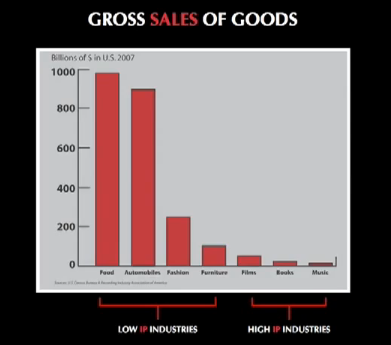
He suggestion here is that lower IP protection results in more production and more revenue. That’s an interesting conclusion.
There’s a variety of interpretations someone could make from that chart.
Since everything in the left section is physical products, everything in the right section is digital products, maybe the lesson is that physical products bring in more revenue than digital ones. Maybe the lesson is that physical products don’t need much intellectual property protection because they’re always tethered to physical items. Or maybe the lesson is that people just don’t/won’t ever spend as much money on books, music, and movies as they spend on necessities like food, automobiles, clothing, and furniture – regardless of the intellectual property protection. I have a hard time believing that eliminating intellectual property protection would somehow cause spending on books, movies, and music to skyrocket 20 or 50 fold – so that they could rival the gross sales of the food and automobile industries. Yet, that seems to be exactly what Blakely is suggesting with this chart. Can you imagine spending as much on music as you spend on food each and every week?
Here’s another little fact: the software industry, which is not shown on her chart, had a worldwide revenue of $304 billion dollars in 2008. This would place it below food and automobiles, but higher than fashion and furniture. I wonder why she left it off her chart.
Update: Another problem I wanted to point out in this video is the fact that one fashion designer copies another designer, the general public is still paying the fashion industry. Now, maybe the second designer can complain about someone else getting paid for their own work, but the consumer is still paying money to the fashion industry (since both designers are part of the fashion industry). On the other hand, when piracy happens with digital media, it’s not creators copying from creators. Rather, it’s consumers getting the products for free — it means the consumer is not paying into the industry. This is another reason why the “high IP / low IP” chart is particularly wrong: because when the fashion industry has low IP protection, the consumer is still paying the fashion industry. In contrast, when digital media has low IP protection, it means the consumer is not paying money to the digital media industry. This suggests that the fashion industry would not be particularly harmed by low IP protection (as measured by the amount of revenue flowing into the industry), but revenue would decrease if digital media had no IP protection.
🙂 Yup, this is how the industry works – from what I hear. (I’m not famous enough to actually know first-hand that this is how the games industry works.)