Pirating My Own Game (Part 2)

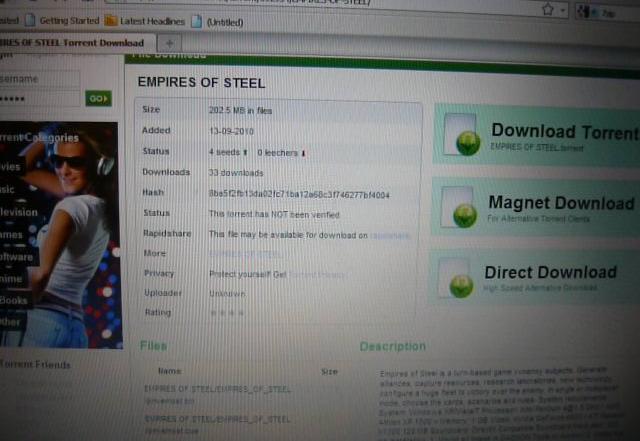
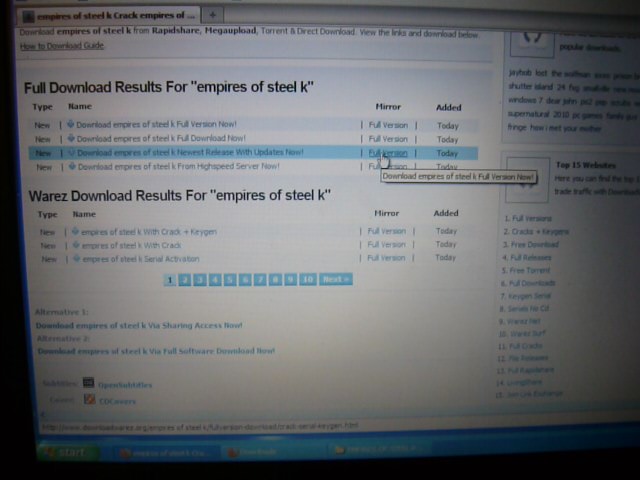
I tried again today to pirate my own game. I was hoping I could manage to avoid a virus this time. I went around and around, visiting dozens of sites. One site, I managed to download a 200+ MB file that was “cracked”. Once I unpacked the rar file, I had a whole bunch of compressed files that I didn’t know what to do with. Most of the other sites I visited required that I sign-up before I could download the file. (They don’t tell you this until you go through a few steps; obviously, they’re using it to drive sign-ups to their site. No idea if they wanted to charge money.) I still remember one pirate site that gave a download description that said the game was “uninspired” (heh, thanks for pirating it and panning it at the same time). At least another pirated copy included the suggestion that “if you like the game, buy it”.

I don’t have any bittorrent software installed on any of my computers, so couldn’t try any torrents. Trying to find a usable copy was a huge headache. It seems like I spent over an hour looking around and ended up with nothing. I eventually just gave up.

While I tend to come down hard on piracy and pro-piracy arguments, I wasn’t really angry when I was looking around for pirated copies. (Strangely, I was angry when I saw that guy at the coffeeshop cracking iPhones and installing pirated apps for people; and none of that piracy involved my own software.) My attitude was more just kind of an apathetic “meh, these things happen” with a curiosity about whether or not they actually have a cracked copy. Part of my annoyance with piracy is just the fact that pirate justifications are so bad. Also, the game’s been out for a year, so it seems like a lot of people who were going to buy the game, have already.


Gettin’ Pirated

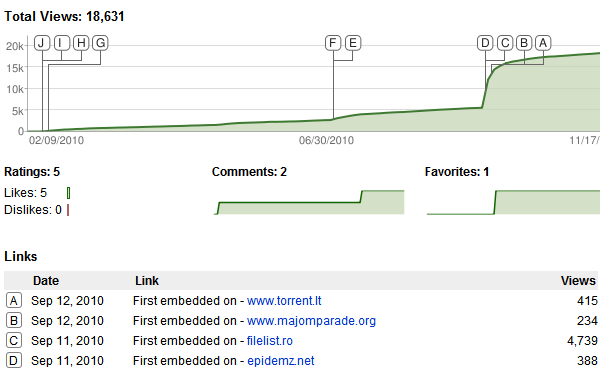
I was looking over some numbers today, and a few things stuck out for me. First, I noticed something on the Empires of Steel video. If you look at the YouTube view statistics, here’s what you’d see:

See the big spike of views on September 11th and about a week afterward, and that the sites embedding the video are pirate sites? The number of views jumped from around 5,000 to 15,000 within a week. I happened to check some of the update numbers around that time, and there was a big spike in the number of people getting updates beginning on September 11th and continuing for a few weeks afterward. Obviously, the game was cracked around September 11th.

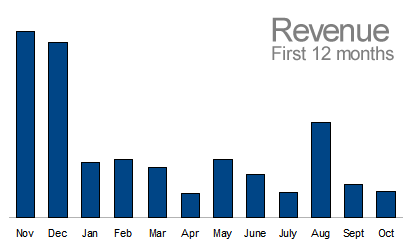
It would’ve been interesting if there was a spike in sales following the same pattern, but there wasn’t. September and the following month were really bad months for sales. As you could see from the chart I posted a few days ago (and reposted below), September was the fourth worst month for sales over the past twelve months, and October was the 2nd worst month for sales. I don’t really think piracy was the reason for the low sales over those months, since that would suggest that “would be buyers” opted for piracy, instead. I suppose it’s possible, but I don’t know.

Nazi Maps For A US Invasion

A friend of mine sent these to me. They’re from March 1942 (four months after the bombing of Pearl Harbor), and they are imagined invasions of the US by the Axis powers. I believe these are invasion scenarios imagined by someone at Life magazine, not authentic invasion plans. (Given that they were published in March 1942, they must be imaginary plans because the US wouldn’t have captured some invasion plans so early.) Some of the maps include a “fifth column”, which makes me wonder if they thought German-Americans and Japanese-Americans would rally to support the invasion of the US.


Click here to see the original article with more maps.

On this topic, it’s also interesting to take a look at the Zimmerman telegram. The Zimmerman telegram was the message sent from Germany to Mexico in 1917 (World War 1) suggesting that Mexico attack the United States. It resulted in the US getting involved in World War 1 against Germany.

10 Centuries of European History

My only criticism of this video is that it should play faster, and should show the year somewhere. If this is ten centuries, then the years should correspond to roughly:

1000 AD – 1100 AD = 0:00 – 0:32
1100 AD – 1200 AD = 0:32 – 1:05
1200 AD – 1300 AD = 1:05 – 1:37
1300 AD – 1400 AD = 1:37 – 2:10
1400 AD – 1500 AD = 2:10 – 2:42
1500 AD – 1600 AD = 2:42 – 3:15
1600 AD – 1700 AD = 3:15 – 3:37
1700 AD – 1800 AD = 3:37 – 4:20
1800 AD – 1900 AD = 4:20 – 4:52
1900 AD – 2000 AD = 4:52 – 5:22

Uh oh, Sales are down

I recently got my sales numbers for the month of October and they weren’t good. To make matters worse, my publisher told me they miscalculated my sales revenue for the month of September – actual revenue was 40% lower than they had originally reported last month.

I had really hoped that sales would stay stable or increase as I added more and more to the game. I was hoping to buck the typical game trend where sales peak on release and then follows a month-to-month decline every month thereafter (with occasional upticks due to sales).

I left off the actual dollar amounts, but this is what the domestic sales revenue looks like for the past year (we have foreign contracts, too, but I left them off since they are short-term income). Hopefully, sales will pickup in the coming Christmas season.

Pirating My Own Game

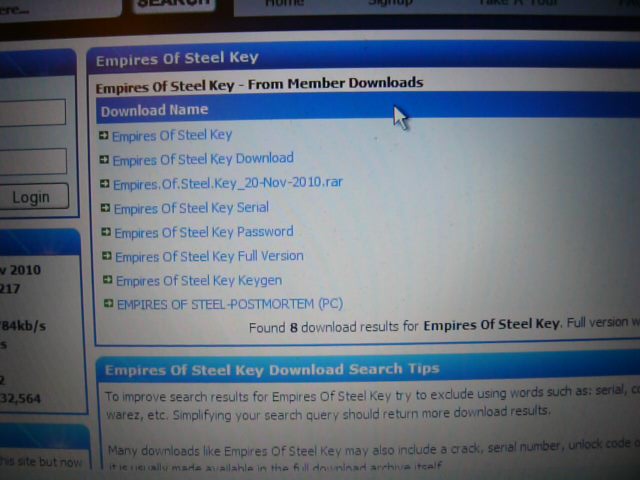
I’ve been signed up for Empires of Steel Google Alerts for a long time now. (For those who aren’t familiar with Google Alerts, you can sign up be notified via email whenever google indexes something matching that search criteria. This lets you know anytime something new appears on the internet.) Well, thanks to Google Alerts, I’ve been noticing what appeared to be pirated copies of Empires of Steel showing up on warez sites. One thing I noticed, though, was that the download size was all wrong – which made me suspicious of whether these were actual pirated copies – as opposed to trojans or copies of the demo. For fear of viruses, I didn’t have the courage to actually visit the sites and download the game to see if it was the full game.

Recently, I got my old laptop back from a friend who was borrowing it. So, I thought, “Why not try it with my old laptop? I’ll reinstall the OS immediately after I try it – that’ll fix the problem of getting a virus.” Today, I tried it. I did a google search for “Empires of Steel”, searching for any free downloads on warez sites. Before I even finished the download, I had obviously been infected by a virus. There was a fake anti-virus program that had installed itself on my computer. Whenever I tried to open any application – even MSPaint – my computer would give me an error saying that the file contained a virus, and I could update my virus protection using their antivirus program. It was obviously a scam to get me to pay them money for “virus protection”. Also, when I attempted to go anywhere on the internet, the “anti-virus” program would stop the connection and tell me that the website was infected and they could fix it. It installed itself into the list of startup programs, so a restart didn’t fix anything. My computer was under the complete control of a virus before I even finished downloading a single pirated copy of my game. And I don’t even know for sure that the website had a pirated copy – maybe it was a garbage file with the name “Empires of Steel” so that they could trap people with their “anti-virus” scam.

Slashdot: Considering a Fair Penalty For Illegal File-sharing

Slashdot: Considering a Fair Penalty For Illegal File-sharing

An anonymous reader writes with this excerpt, following up on yesterday’s announcement of the 1.5 million dollar verdict against Jammie Thomas:

“This week a federal jury handed down the verdict in the third file-sharing trial against a Minnesota mother of four who has been fighting against the charges brought by the RIAA since 2005. Understandably, a lot of people are outraged by this verdict and while reading through comments about the fine on some online forums, I saw some interesting opinions on how these fines should be assessed. The point that $62,500 per song is excessively high seems to be something that everyone can agree on, but what actually is fair seems to be a big point of contention.”(Link)

While I think this is a reasonable question, and think the penalties are absurdly large, Slashdot quickly descended into a chorus of “there should be no penalty; piracy should be legal” arguments with other people voting them up. It’s irritating and frightening to see technology sites decend into this kind of nonsense. It’s like being a store owner and seeing a majority of people arguing that they feel completely justified stealing everything they want from stores [insert thin justification here] – oblivious to the consequences to stores or society. Even worse, I sort of feel a kinship with tech-savy people, so it feels like a betrayal by people who should know better.

What I find most odd about the whole thing is how their judgment changes when some company benefits from piracy. Two days ago, there was a story on Slashdot about a cookbook that took a recipe from the internet. When this was discovered, the company responded with “everything on the internet is public domain; we did the original author a favor”. People weren’t too happy about a company earning money by taking a recipe from an individual and selling it. Yet, so many of the comments in the “Considering a Fair Penalty For Illegal File-sharing” article work equally well to argue for the company’s “right” to take and print up someone else’s recipe.

Some examples:

You are the fool that allows an idiotic fine like this to happen. Pirating music is not like stealing cars. I’ll repeat: pirating music is not like stealing cars. When I download a torrent, NO ONE LOSES ANYTHING. The publishing company doesnt end up with one less copy of the album on their hard drives, the artist doesnt lose the ability to play the song. I would never have paid for that album, and no one who downloads through me would pay for it either. No one loses anything. (Link)

Put into the context of taking someone’s copyrighted material and selling it (as the cookbook creator did):

You are the fool that allows an idiotic fine like this to happen. Pirating [recipes] is not like stealing cars. I’ll repeat: pirating [recipes] is not like stealing cars. When I put [someone else’s recipe in my cookbook], NO ONE LOSES ANYTHING. The [cook] doesnt end up with one less copy of the [the recipe] on their hard drives, the [cook] doesnt lose the ability to [make the recipe]. I would never have paid for that [recipe], and no one who [reads my cookbook] through me would pay for it either. No one loses anything.

Slashdot:

Just because they downloaded does not mean that the product is worth paying for. Besides, this is completely irrelevant. Logically, pirates take nothing from anyone. The only argument that I’ve ever seen (and it’s a terrible one) is the “potential profit” argument. But, really, it’s impossible to steal money that only exists in the future of an alternate dimension where the artist/business made more money. Also, everyone in existence is ‘guilty’ of ‘stealing’ profit that others could, potentially, have had (you ‘deprive’ someone of potential profit merely by choosing not to buy a product). Our illogical capitalistic society is what needs fixing. (Link)

Put into the context of taking someone’s copyrighted material and selling it (as the cookbook creator did):

Just because [the cookbook creator used the recipe] does not mean that the [recipe] is worth paying for. Besides, this is completely irrelevant. Logically, pirates [like the cookbook creator] take nothing from anyone. The only argument that I’ve ever seen (and it’s a terrible one) is the “potential profit” argument. But, really, it’s impossible to steal money that only exists in the future of an alternate dimension where the artist/business made more money. Also, everyone in existence is ‘guilty’ of ‘stealing’ profit that others could, potentially, have had (you ‘deprive’ someone of potential profit merely by choosing not to buy a product). Our illogical capitalistic society is what needs fixing.

This would mean, of course, that the original creator of the recipe (or any writing, music, software, movie, etc) has no grounds to complain if some company takes their work and sells it.

Slashdot:

Has it occurred to you that you are proposing the destruction of the value of human labor on a massive scale?
Nonsense….
That’s what a labor market is like; you get paid for your actual labor, not the fruits thereof, or all the value that the fruits might yield.
If authors cannot sell many copies of their book (the fruit of labor) because people just copy the few that were sold, and then copy the copies, and so on, they’ll just change models or get a better job. Perhaps an author will demand payment up front — $10 per hour of writing, or something — and find that it works better, since no one yet knows how to copy him. (Link)

Put into the context of taking someone’s copyrighted material and selling it (as the cookbook creator did):

It’s perfectly okay for the cookbook publisher to take the recipe or any text written by any author, put it into a book and sell it. The original author should “get paid for your actual labor, not the fruits thereof, or all the value that the fruits might yield”.

How silly that a “lawyer”, of all people, can’t see through the illogicalness of his own statement.

Of course, this can be generalized to a lot more than cookbook recipes – the ultimate outcome being that companies can sell copies of music, books, music, whatever they want because “copying isn’t theft”, and “you can’t prove anyone would’ve bought it (at full price)”. At least there were a lot of comments in the cookbook article attacking slashdotters for their double-standard. Personally, I think the distinction between “free piracy” and “pirate and sell” is a bit of an arbitrary distinction, since most of the consequences are the same.
Influencers [Video]

I have to admit that I take this video with a grain of salt. There’s also something odd about juxtaposing Michael Jordan with Ghandi. Sure, they’re both iconic. But, I’m not sure that Jordan is really much of an “influencer” (in terms of being avant garde or an early adopter) except for the fact that he’s famous for being such a good athlete. Being influential because you’re ultra famous is actually pretty easy.